Operation Paperclip
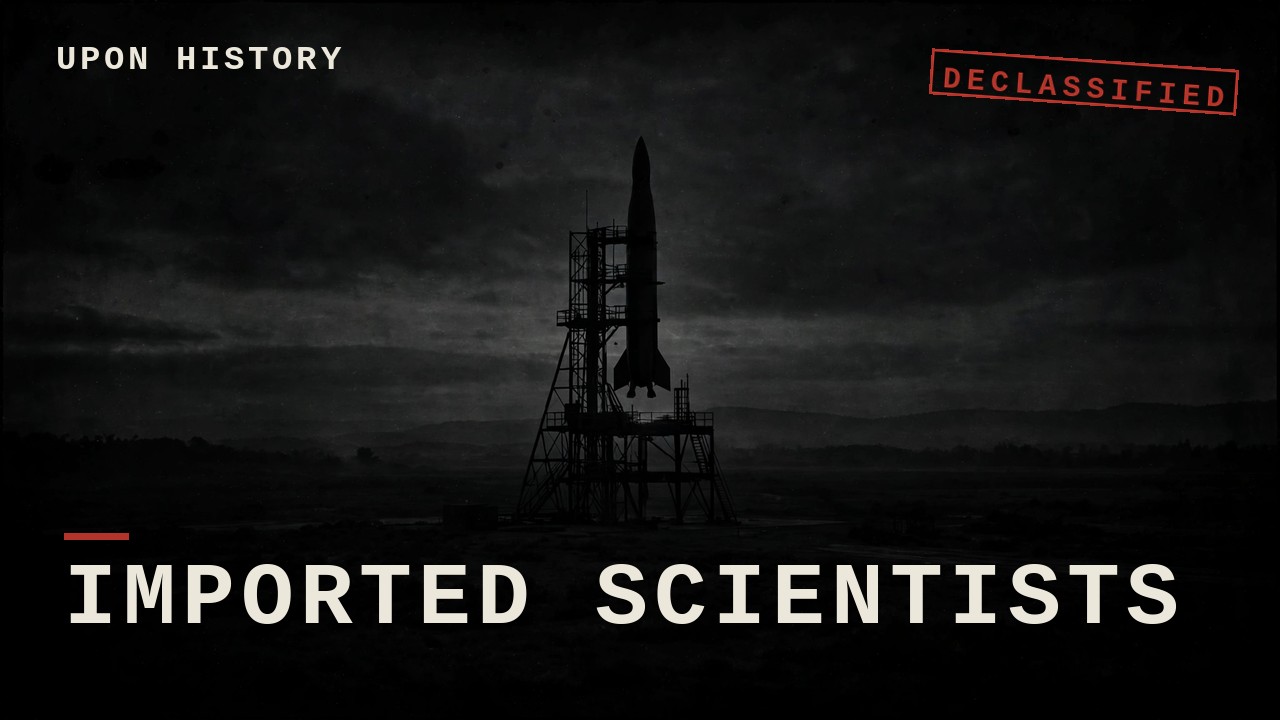
After World War II, the United States brought more than 1,600 German scientists, engineers, and technicians to America under Operation Paperclip — despite President Truman's 1946 directive barring anyone 'more than a nominal participant' in Nazi activity. Investigators later reported that incriminating security assessments in their dossiers had been rewritten before clearance, though the surviving files can't prove the before-and-after. This episode follows the paper trail from Truman's directive to the dossiers — and the SS record the rockets were built on.
TRANSCRIPT
In the spring of nineteen forty-five, the American Army found itself holding something unplanned for: the men who had built Hitler's rockets.
Germany was collapsing. The Soviet Army was coming from the east. And the rocket engineers of Peenemünde had one idea they all agreed on: surrender to the Americans.
So the Americans took them — and over the next decade brought over more than a thousand more: scientists, engineers, technicians, to build America's rockets, its missiles, and its road to the Moon.
There was only one problem, and it had been written down in advance. The President had said: no ardent Nazis.
Somebody tidied up the paperwork.
This is the story of Operation Paperclip — and the files that say what actually happened.
First, the program itself. DOCUMENTED.
The agency in charge was the J I O A — the Joint Intelligence Objectives Agency, set up in nineteen forty-five under the Joint Chiefs of Staff, and the National Archives' own page says it plainly. Quote: 'The J I O A was given direct responsibility for operating the foreign scientist program, initially code-named Overcast and subsequently code-named Paperclip.'
The name, the story goes, came from the paperclips fastened to the files — marking the men whose pasts were the most problematic.
And the count. The Archive holds what it calls the Foreign Scientist Case Files: personnel dossiers on, and these are the Archive's own words, 'over one thousand five hundred German and other foreign scientists, technicians, and engineers who were brought to the United States under Project Paperclip and similar programs.' The commonly rounded figure is one thousand six hundred.
The first rocket men were installed at Fort Bliss, Texas, in nineteen forty-five — testing captured V-twos at White Sands, New Mexico. In nineteen fifty, the team moved to Redstone Arsenal in Huntsville, Alabama. And in nineteen sixty, the whole operation transferred to the new civilian space agency — N A S A — becoming the Marshall Space Flight Center, which built the Saturn Five that carried Americans to the Moon.
From defeated Germany, to Texas, to Alabama, to the Moon. DOCUMENTED.
Now the files. And this is where the story gets interesting.
The dossiers are real. They sit in the National Archives, Record Group three hundred thirty. And the Archive's page names names: Georg Rickhey — tried for war crimes by a U S military tribunal, and acquitted. Walter Schreiber, who ran medical experiments on concentration camp prisoners — and who fled America for Argentina in nineteen fifty-two. Arthur Rudolph, the V-two project engineer — who left the United States in nineteen eighty-four, after the Justice Department caught up with his wartime record at Nordhausen.
And then the Archive adds a sentence of its own. Quote: 'Not included among the dossiers is one for rocket scientist Wernher von Braun. It was never transferred to N A R A.'
The file on the most famous man in the program is not in the Archive. The Archive says so itself.
As for the files that are there — in the nineteen eighties, researcher Linda Hunt spent eighteen months in the declassified files, and reported something the program's managers had never advertised: the dossiers had been edited. Damning security assessments had been replaced with clean ones. A 'security threat' in one version of a file became 'no derogatory information' in a later version of the same file.
In March of nineteen eighty-five, the Washington Post carried the story, reporting that officials had doctored reports on the scientists and ignored evidence of their Nazi activities to get them into the country.
But note the honest label. The files at the Archive are the end product, not the before-and-after. So: the dossiers are DOCUMENTED. The missing von Braun file is DOCUMENTED. The tidying is CLAIMED — reported, not proven.
Now the part of this story that is not a gray area.
The V-two — the rocket that made these men valuable — was built with slave labor. DOCUMENTED.
In the late summer of nineteen forty-three, the S S established a concentration camp near Nordhausen, in central Germany: Mittelbau-Dora. Prisoners were forced to carve a factory out of a mountain — the Kohnstein — tunneling day and night, underground, in dust and darkness, with almost no food and no sanitation. The factory was called the Mittelwerk. Its product was the V-two.
The conditions were murderous. Fourteen-hour days. Beatings. Hangings. Prisoners too weak to work were sent away to be killed. Roughly sixty thousand people passed through the Mittelbau camp system. About twenty thousand of them died.
More people died building the V-two than were killed by it.
On April eleventh, nineteen forty-five, American troops reached Nordhausen and found what was left: the tunnels, the assembly lines, and the dead. The survivors had been marched out days before.
None of this is disputed — it is in the camp records, the liberation reports, and the photographs the Army took that April. DOCUMENTED.
Which brings us to Wernher von Braun.
DOCUMENTED: he was an S S officer. He joined the S S in nineteen forty, and rose to the rank of S S Sturmbannfuhrer — equivalent to major — promoted by Heinrich Himmler himself. He was also a member of the Nazi Party. His American career — Fort Bliss, Redstone, Marshall, the Saturn Five, the Moon — was built on top of that record.
Now the part that is genuinely disputed: what did he know about Dora?
After the war, von Braun described his knowledge as limited — a rocket engineer, he said, not a camp administrator. But historians have documented that he visited the underground factory at the Mittelwerk, more than once. His name appears on wartime correspondence concerning the camp's prisoner labor.
What exactly he saw, what he understood, what he could have done: the record does not settle it. His defenders describe a scientist under a regime that could not be refused; his critics say the visits and the correspondence make the claims of ignorance impossible to credit.
So the labels, applied with care. The S S rank: DOCUMENTED. The Party membership: DOCUMENTED. The visits to the Mittelwerk: DOCUMENTED, in the historical record. The extent of his knowledge of what was happening in the tunnels: UNVERIFIED — asserted by both sides, proven by neither — the man himself is no longer here to be asked.
And now the paperwork.
On September third, nineteen forty-six, President Harry Truman approved the directive that made the program official: S W N C C two fifty-seven, slash twenty-two. And the directive had a condition. Quote:
'No person found by the Commanding General, U S F E T, to have been a member of the Nazi Party and more than a nominal participant in its activities, or an active supporter of Nazism or militarism, shall be brought to the U S hereunder.'
Read that again. More than a nominal participant. An active supporter. Excluded.
The men were screened by the J I O A — and here is what happened next. In February of nineteen forty-seven, the J I O A's director, Bosquet Wev, sent the first batch of dossiers to the State and Justice Departments for review. The State Department's representative on the board called the scientists in that first batch ardent Nazis — and the visas were denied.
Wev was furious. In internal memos he argued the critics were fixated on Nazi affiliations at the expense of national security: the past was paperwork, and the paperwork could be managed.
And it was. The dossiers were revised. The assessments softened. The visas were issued. Men whose early files had marked them as security risks arrived in America as clean assets — and built the rockets.
The directive said: no one more than nominal. The dossiers, after revision, said: everyone nominal.
The directive is DOCUMENTED. The dossiers are DOCUMENTED. The distance between the two is where the investigators found the eraser marks.
Now the labels, applied with care.
The program: DOCUMENTED. The J I O A ran the foreign scientist program — 'initially code-named Overcast and subsequently code-named Paperclip,' in the Archive's own words. The Archive holds dossiers on over one thousand five hundred scientists, technicians, and engineers. Fort Bliss in nineteen forty-five, Redstone Arsenal in nineteen fifty, N A S A's Marshall Space Flight Center in nineteen sixty. The Saturn Five flew to the Moon in nineteen sixty-nine.
The directive: DOCUMENTED. September third, nineteen forty-six: no member of the Nazi Party who was more than a nominal participant, no active supporter of Nazism or militarism.
The camp: DOCUMENTED. Mittelbau-Dora. The Mittelwerk tunnels. The V-two, built with slave labor. About twenty thousand dead.
Von Braun's S S rank: DOCUMENTED. S S Sturmbannfuhrer — major — promoted by Himmler.
And the Archive's missing file: DOCUMENTED. 'Not included among the dossiers is one for rocket scientist Wernher von Braun. It was never transferred to N A R A.'
The tidying: CLAIMED. That security assessments in the dossiers were rewritten to remove disqualifying histories — reported by investigators who compared file versions, carried in the press in nineteen eighty-five, and confirmed or denied in no official file. Reported, not proven.
What von Braun knew about Dora: UNVERIFIED. Visits documented; knowledge disputed. And how many of the 'over one thousand five hundred' would have passed Truman's own test, had the files never been revised: UNVERIFIED. The files, as they stand, all pass. That is rather the point.
Documented: a directive with a condition. Over a thousand dossiers in the Archive — all except one. A rocket built by slave labor in a German mountain. And the S S major who designed the rocket that took America to the Moon.
Claimed: that the files were cleaned up to get the men past the President's condition.
Unverified: what the most famous of them knew — and what the files would have said if nobody had tidied them.
The deadpan truth of Operation Paperclip is the oldest one in the book: the paperwork always says what somebody needed it to say. The directive said no ardent Nazis. The dossiers said no ardent Nazis.
And somewhere between the directive and the dossiers — somebody tidied up the paperwork.
America got to the Moon. The rockets worked. The files are at the Archive.
All except one.
SOURCES
The genuine documents shown or cited in this episode. (5 sources)
- CIA FOIA Reading Room document C00010786 — biographic registers and JIOA dossier material (345 pages, Internet Archive mirror)
- CIA FOIA document CIA-RDP90-01208R000100120031-6 — the CIA's own file copy of the March 12, 1985 Philadelphia Inquirer report on dossier alteration
- 1946 Fort Bliss group photo — Project Paperclip rocket team, NASA via Wikimedia Commons
- Wernher von Braun 1960 portrait — NASA via Wikimedia Commons
- Wernher von Braun NASA color portrait — NASA via Wikimedia Commons


