Operation Gold
In 1954 the CIA and MI6 dug a tunnel under East Berlin to tap Soviet military phone lines, and ran it for nearly a year. The Agency’s own history shows the operation worked exactly as designed — and that KGB mole George Blake told Moscow about it before the first shovel hit the ground.
TRANSCRIPT
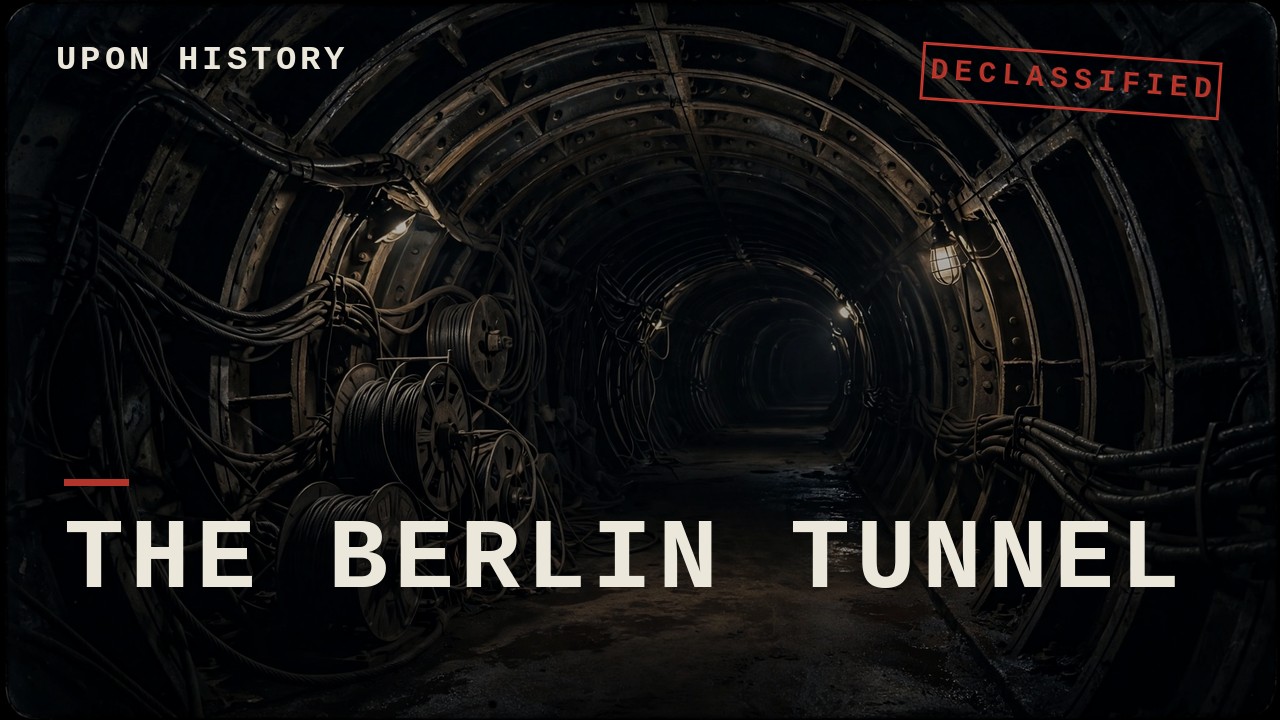
Early in the morning of April twenty-second, nineteen fifty-six. In East Berlin, a Soviet signals crew is working on a washed-out telephone trench when something under their feet does not belong: a tunnel — steel-ribbed, drained, wired with taps — running straight west, under the border, toward West Berlin.
It had been there for nearly a year. Tapping Soviet military phone lines the whole time. Recording everything.
And here is the question the tunnel's builders never got to ask: did the other side know about it before the first shovel hit dirt?
This is the story of the most famous wiretap in Cold War history. It worked exactly as designed. That may have been the problem.
First, the operation itself. DOCUMENTED.
In nineteen sixty-eight, the Central Intelligence Agency wrote its own complete history of the operation: Historical Paper Number one hundred fifty, "Clandestine Services History: The Berlin Tunnel Operation, nineteen fifty-two to nineteen fifty-six." It stayed classified for nearly forty years. In February of two thousand seven, the Agency declassified it.
This history is the DOCUMENTED spine of everything that follows.
Here is what it says. In the early nineteen fifties, the C I A and Britain's M I Six hatched a plan: dig a tunnel from West Berlin under the sector border into East Berlin, and tap the Soviet military telephone cables running underneath — the lines the Soviet garrison and the East German authorities used to talk to each other.
The tunnel was one thousand four hundred seventy-six feet long — roughly four hundred fifty meters. It was dug in nineteen fifty-four and fifty-five, in secret, under the noses of the East German police. The operation's code name was Gold.
The target cables were first exposed on March twenty-eighth, nineteen fifty-five. The taps went live on May eleventh. And they ran until April twenty-second, nineteen fifty-six — eleven months and eleven days of operation, by the history's own accounting.
Eleven months and eleven days. And in that time, the take was enormous.
Now the part the file tells in two voices. And this is where the labels get honest.
First voice: the history's official conclusion. In a memorandum dated August fifteenth, nineteen fifty-six, the Agency concluded that the loss of the tunnel was, and this is the file's own language, "purely the result of unfortunate circumstances beyond our control — a combination of the fact that one of the cables was in very poor physical condition, this was known from the beginning, and a long period of unusually heavy rainfall."
Water got into the trench. The Soviets dug to fix it. And they found the tunnel. DOCUMENTED — that is the Agency's official verdict.
Second voice: the same history. "Subsequent developments," it says, "offer an alternative reason for the demise of the operation." The alternative has a name: George Blake — an M I Six officer who sat in the planning meetings. The history records Blake's own statement: that when the final location decision was made, in late nineteen fifty-three, he informed his Soviet contact.
So the file contains both: the official verdict of rainfall, and Blake's own account of betrayal. What the file does not contain is what Moscow did with what Blake told them.
That is where the reporting takes over. The version most fully laid out in Steve Vogel's twenty nineteen book Betrayal in Berlin — built on interviews with some forty participants — says Blake handed Moscow the tunnel's blueprint before the digging ever started, and that the K G B let the tap run for nearly a year to protect its source. That version is CLAIMED: reported, not proven, and the C I A file is silent on the parts that would prove it.
Blake himself was exposed in nineteen sixty-one, arrested, sentenced to forty-two years in Britain — escaped from prison in nineteen sixty-six, made his way to the Soviet Union, and lived there until his death in twenty twenty. He never disputed the broad shape of the story.
And the history closes the question the way this channel closes questions it cannot answer. Quote: "it is most probable that we will never know the exact rationale behind the Soviet moves."
Now the discovery. DOCUMENTED.
On April twenty-first, nineteen fifty-six — the history's formal date — a Soviet maintenance crew working on the washed-out cable trench broke into the tap chamber. The history's Appendix A timeline runs into the early hours of April twenty-second: that is when the chamber was entered, and the operation died.
Their official story: heavy rains had washed out the ground, and the crew had stumbled on the tunnel by accident. The file records the event. On the weather, the file has already given its verdict: rainfall did it.
And the history preserves the moment in the participants' own words.
Quote: "One of the Germans rather indignantly exclaimed, 'What a filthy trick. And where you would least expect it.' — to which another replied, 'Unless one had seen it for oneself, nobody would believe it.'"
On May third, nineteen fifty-six, the East Germans opened the exposed tunnel to the public — a propaganda exhibition. East Berliners were invited down to look at the steel ribs, the pumps, the taps. The message was written on every face above ground: look what the imperialists were doing under your feet.
The West had its own problem. The operation was blown in the most public way possible — and Washington could not acknowledge any of it. The C I A said nothing. The official silence lasted decades.
Now the question that actually matters: what was on the tapes?
DOCUMENTED — and this time the numbers are the history's own. Some fifty thousand reels of magnetic tape. Twenty-five tons of it. Twenty thousand Soviet two-hour voice reels, yielding three hundred sixty-eight thousand conversations fully transcribed. Thirteen thousand five hundred German two-hour voice reels — five thousand five hundred of them processed, seventy-five thousand conversations. And teletype: eighteen thousand six-hour Soviet reels and eleven thousand six-hour German reels, completely transcribed.
One of the largest recorded harvests in the history of signals intelligence. The Agency's own history treats the operation as a genuine intelligence success: the take was large, detailed, and used.
And then the file goes quiet, and the argument begins.
Here is the problem. If the K G B really knew about the tunnel from the start — and that "if" is doing all the work, because the file never says so — then every word on those tapes is suspect. A tapped line you know about is not a window into your enemy. It is a megaphone.
Did Moscow feed disinformation down the tapped cables — order-of-battle details that were slightly wrong, conversations staged for the microphones? Some historians and former officers argue exactly that. Others argue the K G B could not have managed a deception that large for eleven months without the take still being mostly real.
The file settles none of it. The C I A's history records what the Americans thought they heard. It cannot record what Moscow intended them to hear. So the most important question about the haul — was any of it poisoned? — sits exactly where this channel puts things it cannot prove: UNVERIFIED.
Consider the symmetry. The Americans spent years digging a tunnel to listen to the Soviets. If the K G B's motive was what is claimed, the Soviets spent the same years talking into it — on purpose.
Now the labels, applied with care.
The operation: DOCUMENTED. The C I A and M I Six dug a one-thousand-four-hundred-seventy-six-foot tunnel under East Berlin to tap Soviet military cables. The taps ran from May eleventh, nineteen fifty-five to April twenty-second, nineteen fifty-six — eleven months and eleven days — and produced some fifty thousand reels of tape, twenty-five tons of it: hundreds of thousands of conversations transcribed, teletype reels by the tens of thousands. All of it the Agency's own figures, from its own nineteen sixty-eight history, declassified in two thousand seven.
The discovery: DOCUMENTED. April twenty-first, nineteen fifty-six — the chamber entered in the early hours of the twenty-second. May third, the tunnel exhibited to the East Berlin public.
The official verdict: DOCUMENTED. The August fifteenth, nineteen fifty-six memorandum: rainfall and a failing cable, beyond anyone's control.
And the alternative, in the file's own pages: DOCUMENTED. The history records Blake's own statement that he informed his Soviet contact in late nineteen fifty-three — introduced as "an alternative reason for the demise of the operation."
The betrayal as a story: CLAIMED. That Blake handed over the blueprint before the digging began, that Moscow knew from day one, that the K G B let the tap run for nearly a year to protect its source — this is the account built on participant interviews, most fully in Vogel's twenty nineteen book. It is reported, not proven, and the C I A file is silent on the parts that would prove it.
What Moscow actually intended: UNVERIFIED. Whether the K G B fed disinformation through the tapped lines: UNVERIFIED. What Moscow gained or lost — no declassified document says, the history itself closes with "it is most probable that we will never know," and the side that knows has never said.
Documented: a one-thousand-four-hundred-seventy-six-foot tunnel, dug in nineteen fifty-four and fifty-five, tapping Soviet cables for eleven months and eleven days. Fifty thousand reels of tape — twenty-five tons. A Soviet crew breaking in on April twenty-first, nineteen fifty-six — the chamber entered in the early hours of the twenty-second — and a public exhibition on May third. The Agency's official verdict: rain and a bad cable. The Agency's own file, in the same pages: Blake's statement, late nineteen fifty-three. The complete history, written in nineteen sixty-eight, declassified in two thousand seven.
Claimed: that none of it was a secret. That the other side knew before the first shovel hit dirt, and let the Americans listen for a year — because the microphones were worth more than the man behind them.
Unverified: what Moscow intended, and what it gained.
The deadpan truth of Operation Gold is that both versions of the story are Cold War perfect. If the tunnel was a secret, it was the most audacious wiretap ever built — and it worked. If the tunnel was known, it was the most patient counterintelligence operation ever run — and it worked.
Either way, fifty thousand reels of tape went into the archive. And somewhere in Moscow, on a shelf nobody will ever open, sits the other file — the one that says which of the two stories was true.
SOURCES
The genuine documents shown or cited in this episode. (3 sources)