The Gulf of Tonkin
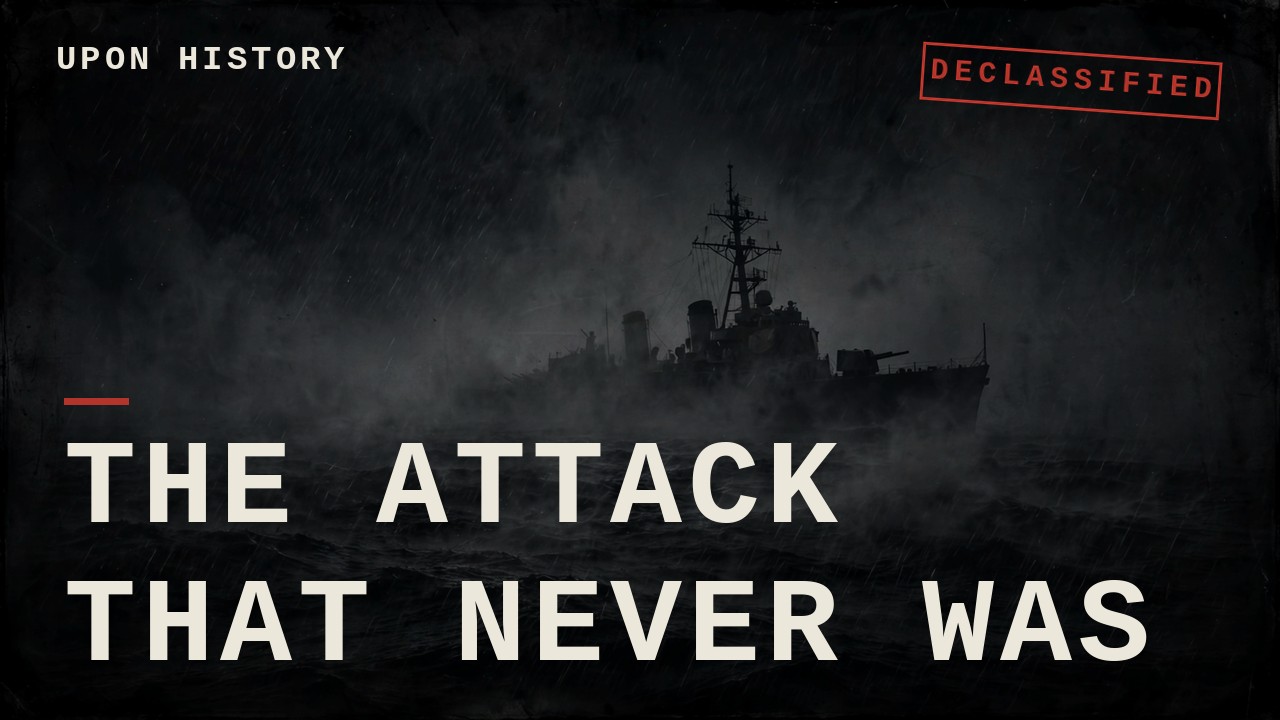
On August 4, 1964, two American destroyers fired hundreds of shells at contacts their own commander soon doubted were real. Three days later Congress passed the Gulf of Tonkin Resolution, the legal basis for a decade of war in Vietnam. Forty-one years later, the NSA’s own historian concluded no attack had happened that night.
TRANSCRIPT
August fourth, nineteen sixty-four. Night in the Gulf of Tonkin. Two American destroyers — the Maddox and the Turner Joy — steam through rain and darkness off the coast of North Vietnam.
Just after nine in the evening, sonar and radar pick up contacts. Torpedo boats, closing fast. The destroyers open fire — hundreds of shells into black water. For hours, the crews fight an enemy they can hear but cannot see.
In Washington, the night's events arrive as a single clean sentence: American ships attacked, for the second time in three days.
Except that while the shooting was still happening, the American commander on the scene was cabling his superiors to say there might be no enemy at all.
Forty-one years later, the National Security Agency's own historian would read the intercepts and tell the story in plain English: no attack happened that night.
This is the story of a battle that never happened — and the war it authorized.
First, the part nobody disputes.
The Maddox is running what the Navy calls a DeSoto patrol — sailing close to North Vietnam's coast, collecting signals intelligence. Meanwhile, South Vietnamese commando boats, with American backing, are raiding North Vietnamese targets along the same coastline. Washington knows the two operations are connected. That connection will matter.
August second. Three North Vietnamese torpedo boats sortie and attack the Maddox — real boats, real torpedoes, real gunfire. The Maddox fires back, carrier aircraft join in, and the torpedo boats withdraw, damaged. A small, sharp, entirely real skirmish. Documented — in American logs, in North Vietnamese accounts, in the damage.
August fourth. The Maddox is joined by the destroyer Turner Joy. That night, both ships report a second attack — torpedo boats on radar, torpedoes in the water. The ships open fire into the dark.
But the officer commanding both ships, Captain John Herrick, is uneasy before the smoke clears. In a series of flash cables that same night, he tells his superiors that a review of the action makes many of the reported contacts look doubtful. His words, from the declassified cable: freak weather effects on radar, and overeager sonarmen, may have accounted for many reports. No visual sightings. No wreckage. No enemy.
Read that again. The commander who ordered the shooting told Washington, within hours, that there may have been nothing to shoot at.
The agency that collected the intercepts would take four decades to agree. In a history declassified in two thousand five, the National Security Agency's Robert J. Hanyok reviewed the signals intelligence from that night and concluded, in his own words: The overwhelming body of reports, if used, would have told the story that no attack had happened. The contacts were phantoms. The battle was fought against weather, nerves, and echoes.
Now watch what happens to doubt in Washington.
On the night of August fourth, the president is on the telephone, and the recordings capture something the public speeches never would: uncertainty. He questions whether the ships were really attacked at all. That much is documented — the tapes exist, and the doubt is on them.
What he personally knew, or believed, in that moment — that is unverified. A recording of a man asking questions is not a confession. It is inferable. It is not provable in a single memo, and this channel does not upgrade inference to fact.
But doubt does not slow the machinery. On August fifth, American aircraft bomb North Vietnamese bases — retaliation ordered before Congress has voted on anything. By August sixth, the secretary of defense is briefing Congress, and the second attack is presented as certain. No qualifications. No Herrick cables.
On August seventh, nineteen sixty-four, Congress votes. The Senate: eighty-eight to two. The House: four hundred sixteen to zero. The Gulf of Tonkin Resolution — signed into law three days later, on August tenth, as Public Law eighty-eight, four hundred eight — authorizes the president to take all necessary measures, including the use of armed force. It is, in effect, a blank check for a war.
The two dissenting votes in the Senate belong to Wayne Morse of Oregon and Ernest Gruening of Alaska. History has been unusually kind to both names.
Three days. From flash cables to war powers in three days.
Now the counterpoint — documented, and on the record.
In nineteen sixty-eight, the secretary of defense sits before the Senate Foreign Relations Committee and is asked, under oath, about the evidence for that second attack. The man who presented certainty in nineteen sixty-four cannot reproduce it in nineteen sixty-eight. Pressed on what the intelligence actually showed, the certainty dissolves into qualifications. Four years after the vote, the foundation of the resolution is being renegotiated in public — by the man who built it.
And then the archive speaks. The National Security Agency's history of the cryptologic record — Skunks, Bogies, Silent Hounds, and the Flying Fish — declassified in two thousand five, concludes, in plain English, that no attack happened that night.
So the timeline reads: August second, a real attack. August fourth, a phantom. August seventh, a resolution. A war authorized by a vote of eighty-eight to two — over a battle that never happened.
So why did it pass — eighty-eight to two, four hundred sixteen to zero? The file suggests four reasons, and none of them is the evidence was solid.
One: speed. Three days from reported attack to the congressional vote. Doubt needs time to harden into opposition. Nobody gave it any.
Two: the election. Nineteen sixty-four is a presidential election year, and the challenger is running on the claim that the president is soft on communism. Three months from the ballot box, no president gets to look hesitant.
Three: certainty, performed. Congress did not vote on Herrick's cables. It voted on a briefing that presented the second attack as established fact. The doubt stayed in the cables. The certainty went to the floor.
Four: the context, withheld. Congress was not told that the Maddox was on a signals-intelligence patrol, operating alongside covert South Vietnamese raids against the North — raids Washington knew could provoke exactly the kind of incident the resolution was answering. The vote was taken on a story with the first chapter torn out.
Now the labels, applied with care.
August second: documented. A real, small North Vietnamese attack on the Maddox. Real boats, real fire, real damage. Nobody disputes it — not even Hanoi.
August fourth: claimed at the time, documented now as a phantom. The Navy reported a battle. The National Security Agency's historian, with forty years of intercepts, concluded that no attack had happened that night. The file closed the case the cables had already opened.
The president lied to start a war: unverified. The August fourth recordings document doubt — a president asking whether the attack was real. They do not document a confession. What he knew, believed, or chose not to know is inferable, and inference is not evidence. This channel will not convict a man on a tape of him asking questions.
Congress was given all the facts: contradicted by the record. The covert context — the intelligence patrol, the South Vietnamese raids — was not in the briefing. The vote was real. The information was not complete.
And the secretary's two appearances: documented counterpoint. Certainty in nineteen sixty-four, qualifications in nineteen sixty-eight. The file does not say he lied. It says the certainty was never as solid as the vote required it to be.
Documented: August second, a real attack. August fourth, a phantom — in plain English, what the National Security Agency's own historian concluded: no attack happened that night. August seventh, the congressional vote — the Gulf of Tonkin Resolution: Senate eighty-eight to two, House four hundred sixteen to zero. Signed on August tenth as Public Law eighty-eight, four hundred eight. A decade of war, authorized in three days.
Unverified: what the president knew that night. What the secretary believed versus what he sold. Whether a slower Congress would have voted differently.
The file's deepest cut is not the phantom battle. It is the speed. Doubt reached Washington within hours — in Herrick's cables, on the president's tapes — and the machinery outran it anyway. Three days from a battle that never happened to the legal authority for a war that did.
SOURCES
The genuine documents shown or cited in this episode. (3 sources)
- Robert Hanyok’s NSA history “Skunks, Bogies, Silent Hounds, and the Flying Fish: The Gulf of Tonkin Mystery, 2–4 August 1964” (declassified 2005)
- Public Law 88-408, the Gulf of Tonkin Resolution (78 Stat. 384, approved August 10, 1964)
- Official U.S. Navy photograph of the USS Maddox (DD-731), via DVIDS (public domain)